
Sources for Past Layton Addresses
Previous residents appear in different records depending on the era. The Recorder supplies the strongest recorded transaction trail. Directories and newspapers show dated occupants or community ties. Census images add household structure when the released year and address detail fit. Building records may show an applicant or project, not everyone who lived at the property.
| Source | Years It Covers | Where Held | What It Shows |
|---|---|---|---|
| Davis Recorder / REDI-Web | Office context 1850; land collection 1870; modernization 1981 | Davis County Recorder | Parties, deeds, plats, legal descriptions |
| Davis County Clipper | 1892–1992 | Davis County Library | Obituaries, notices, addresses, family links |
| Layton newspapers | 1925–1950 title sequence | Library of Congress and libraries | Dated local reports and address clues |
| City-directory examples | 1890; 1959; 1975; 1977–78 inspected | University of Utah collection | Name, role, organization, address snapshots |
| FamilySearch Davis catalog | 1869–1953 | FamilySearch images where permitted | Historical deed, marriage, probate leads |
| CityInspect permits | Digital process from 2019 | Layton City | Applications, plans, status if released |
Begin with the parcel when the house still exists. Start with a newspaper, archive, or family record when only a person or historic place name is known. The coverage dates above are research markers, not a promise that every Layton item is digitized.
Layton Previous Residents: Deed Chain
Start with the current parcel result, legal description, and owner display. Then find the purchase document in the Davis County Recorder or REDI-Web index, identify the seller, and search that party backward. Reconcile every step with parcel, legal description, date, spouse or entity notation, and document type. A matching name without those controls is not enough.
- Pull the current owner, situs address, parcel or serial number, and legal description from Property Search.
- Use the parcel or address in REDI-Web and inventory the current purchase document entry.
- Read the indexed parties and search the seller as a prior grantee or party.
- Repeat backward, checking legal description, date, document type, and related entries at each step.
- When the online trail ends, ask about office terminals, deed books, microfilm, Archives, or FamilySearch.
- Grantor / grantee
- The grantor conveys an interest; the grantee receives it.
- Chain of title
- The linked sequence of recorded conveyances associated with the same land.
- Legal description
- Recorded land language, such as subdivision, lot, block, or survey terms, that can outlast a street label.
Layton Previous Residents in REDI-Web
REDI-Web searches by name, address, parcel, or document number and provides images or abstracts for recorded documents, plats, and surveys, with print or download options. The Recorder’s office context reaches back to 1850, historical land collection begins in 1870, and computerization and microfilming began in 1981. The exact oldest online image year was not located.
Subscription access is $25 per month plus download or other fees. The Recorder lists a $1 online digital-document copy, $2 per page for in-person or mail copies, and $5 certification plus $2 per page. Use a narrow request for an identified document. The office does not perform title searches or give legal advice.
Inspect the Davis County REDI-Web information before ordering a historical image.

Keep the parcel, entry number, document date, parties, legal description, and image status with the citation.
Layton Previous Residents and Old Names
Heritage Museum history places the community in a Kaysville agricultural extension in 1850, with Kays Ward and Freedom used in different periods. The Layton post-office name appears in 1886, separation from Kaysville in 1907, and incorporation in 1920. East Layton and Laytona also occur in later development or annexation references.
Search those names with the county and approximate date. A newspaper address may use a park, court, ward, rural route, or subdivision name. No official pre- and post-address crosswalk was found, so use a parcel legal description or a targeted city/county request to prove continuity.
Layton Previous Residents in Newspapers
Davis County Library’s searchable Clipper run covers 1892–1992. The Layton Weekly News-Express runs from 1925 to about 1940 in the Library of Congress catalog, followed by the Layton Journal from 1940 to 1950. Search surname variants, old place names, and neighborhood terms such as Verdeland Park, O-Court, and H-Court.
An obituary, legal notice, wedding, business announcement, or social item can tie a person to a dated address or family relationship. Keep the event date separate from publication date. A newspaper reference may be a former address and should not be read as a current situs.
Layton Previous Residents in Archives
Utah State Archives offers Second District Davis County index books, Davis birth and divorce indexes, statewide death and delayed-birth indexes, and digital collections. FamilySearch’s Davis County catalog covers 1869–1953 with images of originals where access permits. The Davis County Records Catalog is a finding aid, not a digital repository.
Preserve series, box or volume, page or image, repository, and access date. A no-result modern portal may mean not indexed, not digitized, restricted, or held elsewhere. That distinction is central when searching previous residents.
Use the Utah Archives Second District Davis indexes when an older court or county trail is not in a modern portal.
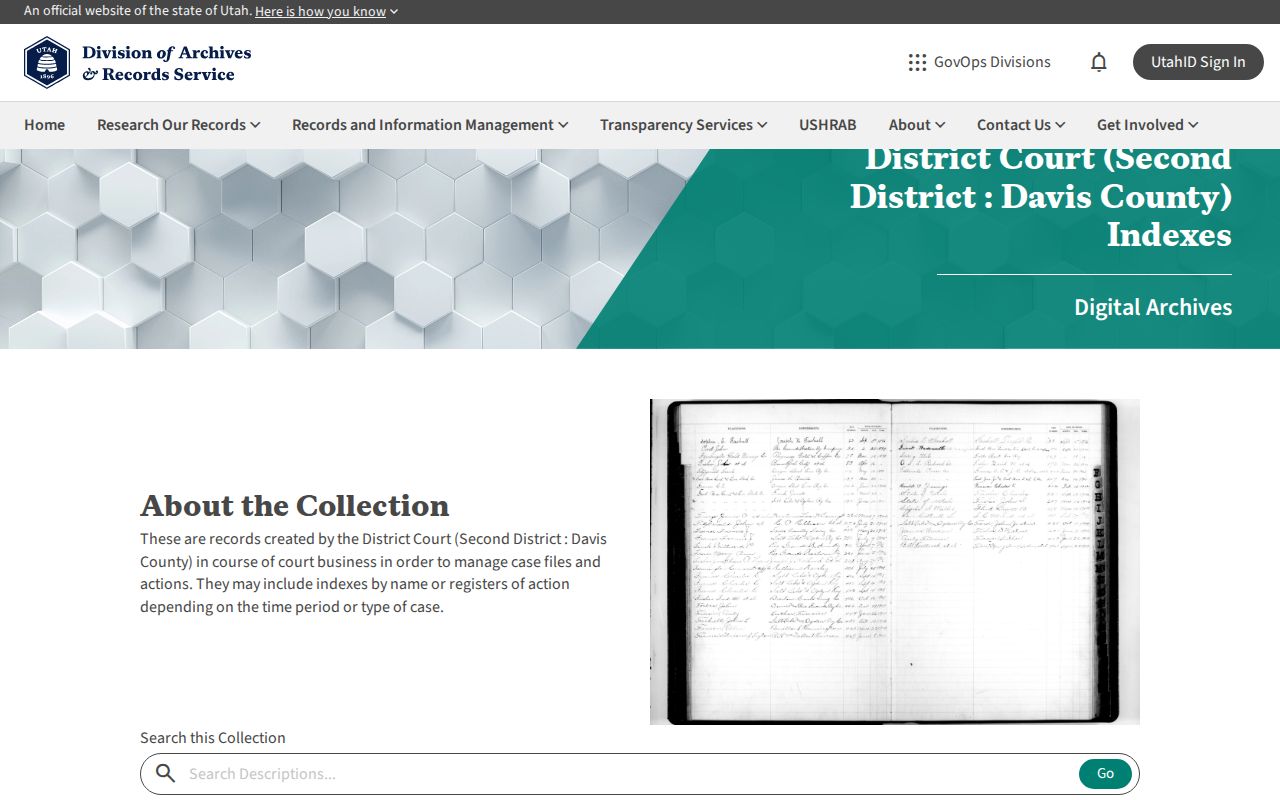
State Archives guidance also directs historical requests toward names, maiden names, location, county, agency, approximate dates, and record type. A narrow request gives the archivist a useful search frame and helps separate a missing index from a missing record.
The older trail has more than one doorway. Use the Archives indexes for a browsable lead, FamilySearch for the Davis County catalog and permitted images, the Davis County Library for dated newspaper context, and the Recorder or Clerk for an identified document request. A finding aid, a scanned image, a certified copy, and a staff response are different kinds of evidence and should be labeled separately.
When a clue points to a court or county index, include the person’s name variants, maiden name when known, Layton or older place label, approximate years, agency, and record type. A narrow request lets the custodian distinguish an absent index from an absent record and gives the previous-residents trail a clear stopping point.
Layton Previous Residents and Census Years
Use a city directory as a dated name-and-address snapshot, then pair it with a released federal census year, newspaper, deed, obituary, or probate source. The directory may show one householder while the census supplies household structure. Neither source should be forced to fill the other’s gaps.
- Copy the exact directory name, address, volume, page, and place label.
- Check the closest available census year and preserve the enumeration geography.
- Compare a deed date or newspaper notice for the move or ownership event.
- Use probate or obituary material only when the source connects the person and date.
The final trail should say what each source proves. A deed establishes a recorded transaction, a directory supplies a dated listing, and an obituary or probate notice supplies an event or relationship only if its text makes that connection.
Do not turn the last deed into a death date or a newspaper address into a legal situs. A seller’s later transaction may offer a location clue, but it does not prove that the seller moved there. Those distinctions keep previous residents research honest.
A house-history note should also preserve negative evidence. Write down the date range searched, the exact address variants, the parcel key, the repository, and the reason a source did not answer the question. “Not located in the official sources inspected” is more accurate than “never lived there.”
When an older address appears under Kaysville or Freedom, keep that wording in the citation and add Layton only as a modern location note. A later map can help, but an inferred crosswalk should be labeled as inferred because no comprehensive official table was found.
For a move between two owners, compare the recording date, document type, grantor and grantee roles, legal description, and page or image reference. A gap between filings is a research gap, not proof that the parcel was empty. Search the same address with its parcel key and historical place names before asking a custodian for a targeted copy.
A complete house-history citation can carry both positive and negative findings: the source searched, the date range, address form, parcel key, image or page, and why the next link was not located. That record keeps a later researcher from treating a gap in the online index as proof that no earlier resident or filing existed.
Past Households, Directories, and Obituaries
Owners are only one layer. A directory or newspaper can show a household name at an address, while an obituary, probate notice, or vital index may explain a later disappearance. The Layton city directories page covers how the collections are read; the backward address trail belongs here.
No verified Layton-specific criss-cross directory or Sanborn map run was located. Do not invent a last occupant from a missing volume. Mark a result as no current public result, not indexed, restricted, or not located in the official sources inspected.
Lawful use. Previous-resident research is for house history, genealogy, reconnection, and personal curiosity. Do not use a record to track, harass, intimidate, or harm a living person.